
Facility Design and its Impact on Retention.
At times of economic challenge retaining customers is important to all business. This article is intended to identify issues that can contribute to increased retention and decreased attrition in the design of our gym spaces.
Gyms evolved in the UK market first in the public sector. The introduction of the early universal multi-gym provided users with their first experience of weight training that was not reliant on free weights. Body building gyms existed but these were dedicated to a small minority of users who’s sole aim was to sculpt their shape rather than gain fitness related benefits.
As facilities evolved so did the machines found within them. Universal was followed by Nautilus and then by domestic and foreign manufacturers. Schwin Air-dines gave way to Life cycles, square tubed resistance machine with tall weight stacks gave way to curved frames and low profiles. The range of machines grew and so did the size of the space required to house them.
While the equipment has grown ever more sophisticated the layout of the gym has not. Many gyms still are designed around the old bodybuilding principles of grouping body parts together. Chest press, Pec Dec, shoulder press, all close by to facilitate training based on muscle development principles. Laying out the CV machines in straight lines, in order of height facing the same direction.
While this may allow for the most efficient use of space it has not been conducive to the adoption of regular participation. Gyms following this traditional approach have generally been designed by exercisers or staff for those that are already comfortable in this arena. Exploratory research in gym design and lay out, is beginning to show that breaking away form, clusters of resistance machines and rows of CV facing a few big TV’s has can improve the early adoption to exercise.
“Initially you see a nice gym, but every time you go you just seemed to see the same machines over and over again.” FIA, Winning the retention battle, part 5, 2002.
An observational study conducted at one facility required the research to follow exercisers as they moved around the gym. When carried out with sufficient numbers, patterns begin to emerge that help explain user behaviour. Where do most customers start, then where do they go, what do they use and how do they use it. This is similar to the work conducted in retail settings to identify buyer behaviour. Understanding how new and existing exercisers use a space can help in designing changes and the development of evolutionary gym experience.
“Respondents left clubs because they felt that the physical environment offered by the club was not conducive to engaging in exercise.” FIA, Winning the retention battle part 4, 2002.
With a few exceptions most gyms have to fit within existing facilities, some of our buildings were never designed with a gym in mind or as an after thought. But if we were to take a blank sheet of paper and design a gym, that focuses on providing an evolving experience, for new to exerciser and committed exerciser, would it look the same.
Would we have our free weights up front close to the entrance? Would we provide and audio visual experience that allows customers to modify and adapt it to their own tastes, like Virgin Atlantic or provide rows of machines opposite a few TV’s, in the way we used to watch a film at the front of a cabin that we had no control of. Stanstead airport is a good example of a facility designed to provide customers with a basic route from entrance to aircraft. It is a lot less difficult to navigate around that Gatwick or Heathrow which have were designed around the airline and operator requirements rather than the experience of the customer.
Another area to consider is the layout of the equipment. Many uses forgo the use of programme cards once they have some idea of where they need to go. So why don’t we layout equipment in away that does not require them to seek it out. An example of this would be to place machines in a straight line or a curve in an order that for the majority of users would give them a whole body workout if they started at one end and worked their way to the other.
Splitting up CV machines into smaller groups makes them less intimidating to use for new users, especially at peak times.
We also need to consider how our staff will be able to facilitate the most basic of interactions form the layout of the equipment. If all of the machines are facing the wall, what opportunities will be available to them and what is the experience for the user.
Who decides what goes where? Well if we just leave it up to the majority of manufactures they will endeavour to sell you as much equipment as will physically fit and in some cases more. If we leave to our gym staff, many will design the gym around their own preferences and workout routines. One way may be to think about the new to exercise or someone you know who has never used a gym.
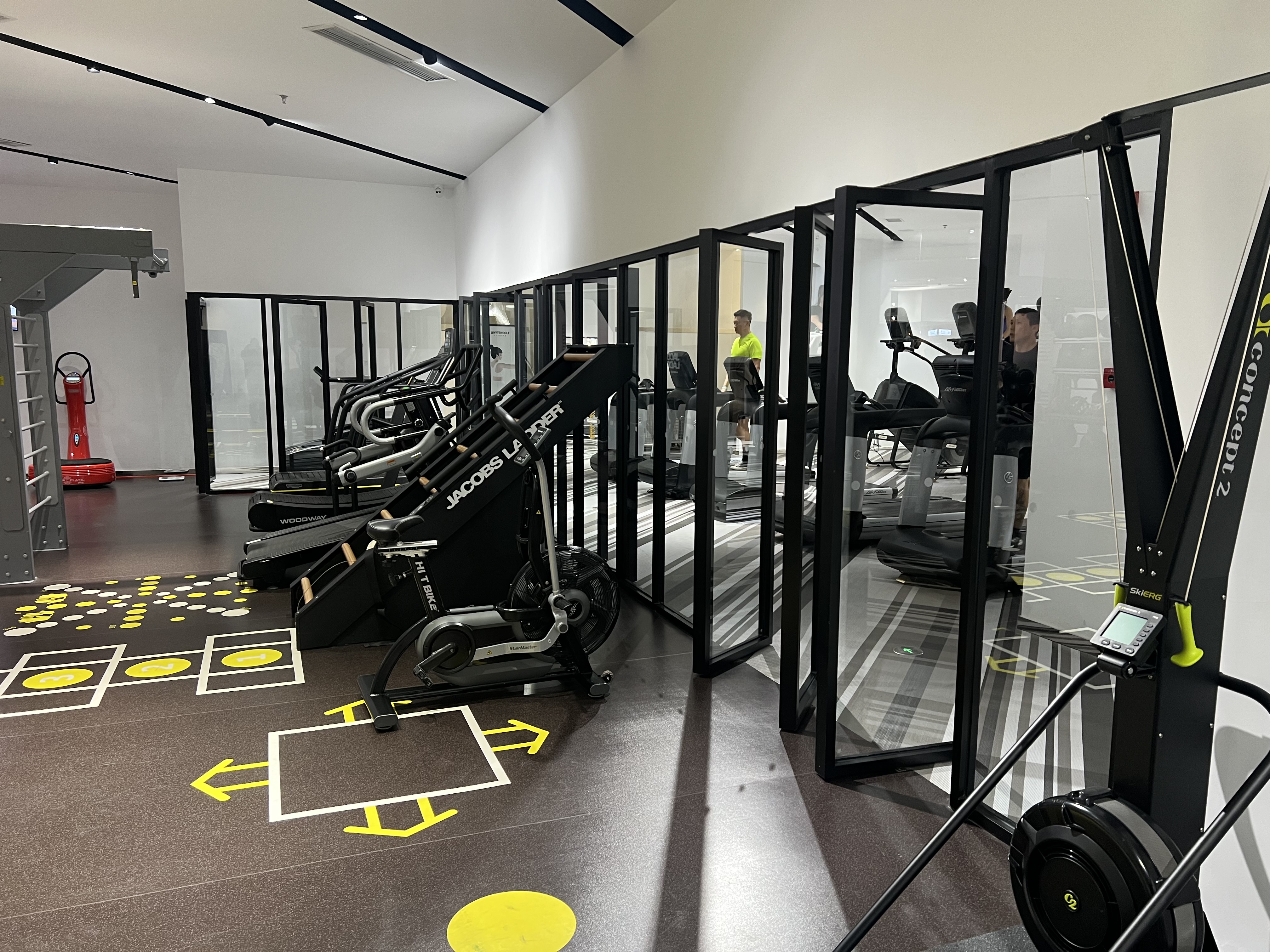
Picture Paul Bedford Whytte Wollf Bejing China
What would they need to experience first and then what and over time as their confidence and competence grows how can we evolve that experience to include more. This may be achieved using zones, just make sure that the zones don’t act as a barrier to participation and engagement.
“After about three or four months the novelty of joining the gym began to wear off, it just wasn’t as interesting anymore. At first it was like it’s completely new, ‘ooh what can I go on next?’ I was probably going nearly about three times a week.”
FIA, Winning the retention battle, part 5, 2003
I have recently witnessed a gym that has laid out it’s CV machines in a way that allows for the delivery of group sessions. During the morning a group of older adults used the machines and its layout facilitated easy conversation, which provided some distraction from the routine of exercise. However in the evening these same machines were occupied by individuals, all exercising with the heads down so as to avoid eye contact with each other. Probably the most worrying issues was the fact that the fitness team were not providing any group exercise sessions at all, at any time. Now for me the evidence is not sufficient to state people who use cardiovascular machines in the gym environment have higher levels of adherence than those that don’t. So does that mean we should not do it? No it just means we should consider if that type of layout is appropriate for your users and will it be maximised when not delivering group sessions.
What I have seen in observational studies that I have conducted, is that committed exercisers, who are confident and competent will use almost any equipment in any setting to complete their workout. Where as those new to exercise will avoid almost all situations where their feel unconfident, may look incompetent or draw attention themselves.
Placing your new circuit line equipment, in a location close to the entrance, adjacent to some cardiovascular machines and which is in partially screened off from the rest of the facility may go some way to assist new exercises in get started. No need to venture to far into the gym. Less likely to be confronted by an exercise addicted gym bunny. Placing the same equipment next to the free weights areas, so that your three personal trainers can have more floor space to work with a few clients on stability balls is not going to help. Which is the reason why one fitness manager, I visited recently, changed the layout of the gym that had been designed to facilitate the concept of an on going exercise experience.
A separate observational study that I conducted allowed me to use the existing closed circuit TV system in the gym to monitor instructor and customer behaviour. Analysis of the video identified that when staff toured prospective members around the gym they often stopped in areas where experienced exercisers were engaged with high intensity workouts. Even without sound, it was still possible to see the body language of the customer and identify if they were themselves a regular exercisers or someone new to the gym environment.
We may also go some way to re think the wall coverings and the messages our poster and notice boards project. With the advancement in print technology it is possible to produce information for the customer that is useful and of a sufficient quality to attract their attention. Images of exercise may need to include a range of activities not just images of people posing their muscles. The use of mirrors should be considered and used where most needed, such as free weights area.
Look at your space, study how people use that space. Do new exercisers have an opportunity to develop confidence and competence without intimidation? Can the exercise experience evolve over time to suit the needs of all the customers? Does the facility facilitate interaction if required between staff and customers, or is it designed as one persons playground?
Originally printed in the ISRM magazine.
Join our Free Retention Guru Community
This group is for those who want to increase retention, reduce attrition and improve the customer experience in a health club environment. It's here for you to share your wins, your challenges and your experiences. It’s here so that you can find support and be supportive.

8 most common mistakes operators make.
Simply enter your name and email to download your free copy today!