
Satisficing vs. Optimising: How Members Really Choose How to Exercise
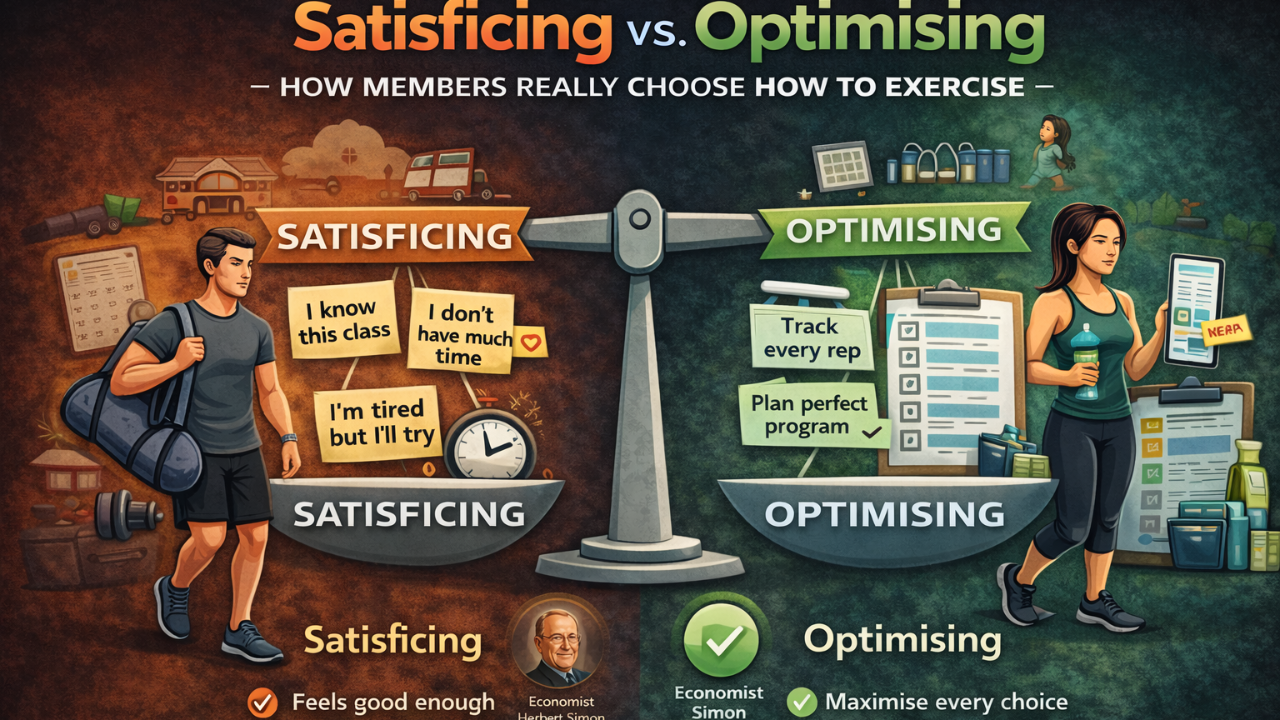
In the fitness industry, we love the idea of the optimal workout. The perfect plan, the perfect programme, the perfect path to results.
But most health club members don’t live in a world of optimisation.
They live in a world of work schedules, school runs, low confidence days, lost motivation, and “I’m tired but I’ll try.” They make decisions not as robots calculating best outcomes, but as humans navigating real life with limited time, fluctuating energy, and imperfect information.
Economist Herbert Simon called this bounded rationality, recognising that people rarely choose the “best” option, they choose the first one that feels good enough.
That behaviour has a name: Satisficing. Rather than trying to maximise every choice, people choose the option that meets their minimum requirements and when we apply this to exercise behaviour, everything suddenly makes sense.

Why Most Members Don’t Optimise Their Workouts
If optimising were the norm, every member would:
- Track progressive overload
- Periodise their training
- Balance strength, cardio, mobility and recovery
- Train consistently 3–5 times per week
But the majority don't. Not because they don’t care, but because perfection is exhausting. Optimising requires research, expertise, confidence, and a controlled environment. Most people simply don’t have the cognitive bandwidth to do this every time they walk into the gym.
Satisficing, however, feels manageable:
“I’ll go to the class I know.”
“I’ll do 20 minutes instead of skipping entirely.”
“I’ll pick a machine that isn’t intimidating.”
These choices aren’t lazy they’re rational when life is unpredictable.
The Science Behind It: Self-Determination Theory
Self-Determination Theory (SDT) shows that long-term motivation thrives when people feel:
Autonomy — I choose this
Competence — I can do this
Relatedness — People like me do this too
Optimising can threaten all three:
- Too much complexity kills autonomy
(“I have to do this exact routine, or it doesn’t count”) - High expectations damage competence
(“I’m so far off optimal, what’s the point?”) - Hyper-individualised training reduces connection
(Everyone is doing their own thing)
Satisficing often supports all three:
- Members choose what feels doable
- Success is immediate and confidence-building
- They often join others in group settings
This is why group exercise is a strong retention driver in global studies, it is a satisficing environment that maximises basic psychological needs.

The Problem with Perfection
Optimisers, those who try to find the best possible option, often feel worse after choosing. Too many possibilities lead to, overthinking, regret, inaction and drop-out. A member scrolling YouTube for “the best abs workout” may end up doing nothing at all, except watching videos. Perfection becomes the enemy of progress.
Satisficing Helps People Stick with Exercise
A satisfier walks into the gym thinking:
“Anything that moves me forward today is enough.”
That is powerful. Because consistency always outperforms perfection. A 20-minute workout beats a missed 60-minute one. A familiar class beats the discomfort of going home. A “good enough” habit beats the “perfect plan” that never starts. The most successful members are often not the most strategic, they are the most consistent. They choose doable, not optimal.
Real-Life Member Examples
Satisficer. Arrives late, joins half of Body Pump, leaves feeling proud they showed up and returns tomorrow.
Optimiser. Arrives late, has left their tracker at home, refuses to join class already in motion, believes the session is ruined and goes home, feels like a failurer.
One builds momentum the other one builds self-doubt and from a retention standpoint, the winner is clear.
How Health Clubs Can Design for Satisficing
Instead of asking members to restructure their lives around the gym, design experiences that fit their lives. I’ve talked about this for years. When I was a Personal Trainer I had clients that were accountants. They were well paid, disciplined and love structure. The only problem was the end of the month when they had to do the months accounts and pay roll. This week to ten day period create massive disruption to their training routine so we devised training plans that had 3 sessions per week in the first three weeks of the month and then two sessions in the fourth week and optional sessions in the final week. We also varied the length of the sessions from 40-60 minutes.
If I were still training clients before developing an exercise plan I would ask to see their weekly/monthly schedule and together we would work out where they could fit exercise in, around their existing commitments.
Other things you could do include:
- Drop-in, low-barrier classes that remove timing pressure
- Quick wins in onboarding (confidence before complexity)
- Visible progress cues stamps, streaks, badges
- Stations-based floor layouts “just start here circuit approach”
- Gamified challenges where small actions count and avoid leader boards
When success feels achievable, people repeat the behaviour. Movement becomes enjoyable. Exercise becomes identity.
A Simple Shift for Staff
Instead of saying: “Here’s the optimal training split for your goals.”
Try:
“What feels manageable this week?”
“What’s one small win you know you can hit?”
“Where do you feel most confident starting today?”
This builds:
Autonomy - They choose
Competence - They win
Relatedness - They feel supported
That emotional combination keeps them coming back.
The principle of "Good Enough" is the Principle of Retention
Members don’t leave because the gym failed to optimise their programme.
They leave because they didn’t feel successful.
Optimisation focuses on potential, satisficing focuses on progress.
And progress even small, imperfect progress, is what creates belief, “I can do this. This is for me. I belong here” and that is the moment retention is secured.

Final Thought
Not every workout needs to be the best workout. But every workout needs to leave the member feeling like they can come back. When we design environments that celebrate “good enough,” results take care of themselves. And more importantly members stay long enough to experience those results.
Because in the real world…
Good enough is what keeps people going.
Join our Free Retention Guru Community
This group is for those who want to increase retention, reduce attrition and improve the customer experience in a health club environment. It's here for you to share your wins, your challenges and your experiences. It’s here so that you can find support and be supportive.

8 most common mistakes operators make.
Simply enter your name and email to download your free copy today!